The power of social media, on the most global of scales,
is that it has the ability to connect persons who might otherwise never
interact, never form relationships, and never communicate with one another
(Ahmad 2016). On the level of cost, those seeking to reach out to others are
also able to do so with little monetary effort. With the growth of social media
continually
on the rise (White 2013) there is a large online audience within the reach
of those looking to “spread the word” on any given topic or cause. Groups or
individuals wishing to advocate or organize will inevitably utilize these
ever-growing channels to perpetuate action, or at least to distribute
information. The reality is that, like any effort to spur on change, social
media tools have both benefits and disadvantages, and ultimately, may not
always create the culture to spur on real-world action beyond the “walls” of
the internet.
The Benefits of Social Media Activism
Social
media has its benefits to those seeking social or political action. Networking
sites can be used by those looking to organize events, groups, and coordinate
activities such as fundraisers or awareness events all at the click of a
button. The convenience of organizing without having to physically meet or congregate
during the planning phase allows advocators/fundraisers/etc. to pull together
events quickly and conveniently. Sites like Facebook are set up to display
information like times, places, participants, photos and discussion forums that
aid coordinators pull together information in an organized and simple format. Beyond
the simplicity of the medium itself, online organization through social media
often gives users a voice; aids in building trust and participation between
those involved, and empowers
those involved to become content creators and distributors as part of their
active participation online – activities such as putting together a
Facebook event, tweeting out info on a cause, or sharing photos on Instagram
that perpetuate the message can all empower persons who might not otherwise
become involved and encourage those online participants to begin the work of
becoming more physically involved.
The Problematic Nature of Social Media Activism: The Need
for “Offline” Action
There is research that has revealed that many people
are now turning to social media to both read the news and to express political
opinions. As a result, the natural progression is that social media is being
used to join causes and to mobilize information and becoming the primary way to
do so (Valenzuela 2013). With more and more online political awareness, it’s
important to analyze the real-world results of such campaigns. Camila Segovia
of the Brown Political Review examined the relationship between three different
hashtag activism campaigns and their relationship to solutions. She found that
these movements (see picture below for summary) inevitably raised awareness but
did little to solve the issues they raised. In summary, Segovia highlights two
important aspects of online activism that has the potential to create
dangerously ineffective campaigns: “…it is important to remember that the
social media platform is a means, not an end, for political action…Expanding
political activism on Twitter should no substitute efforts undertaken in the
offline world” (Segovia 2014). When users become involved online or participate
in an online campaign, it is essential for those participants to consider how
they could become more involved in a real-life working way. If there is no
political action, that is, the physical and real plan to save the girls
kidnapped by Boko Haram, then the campaign becomes fruitless. After all, a
hashtag can’t travel to the Sambisa Forest.
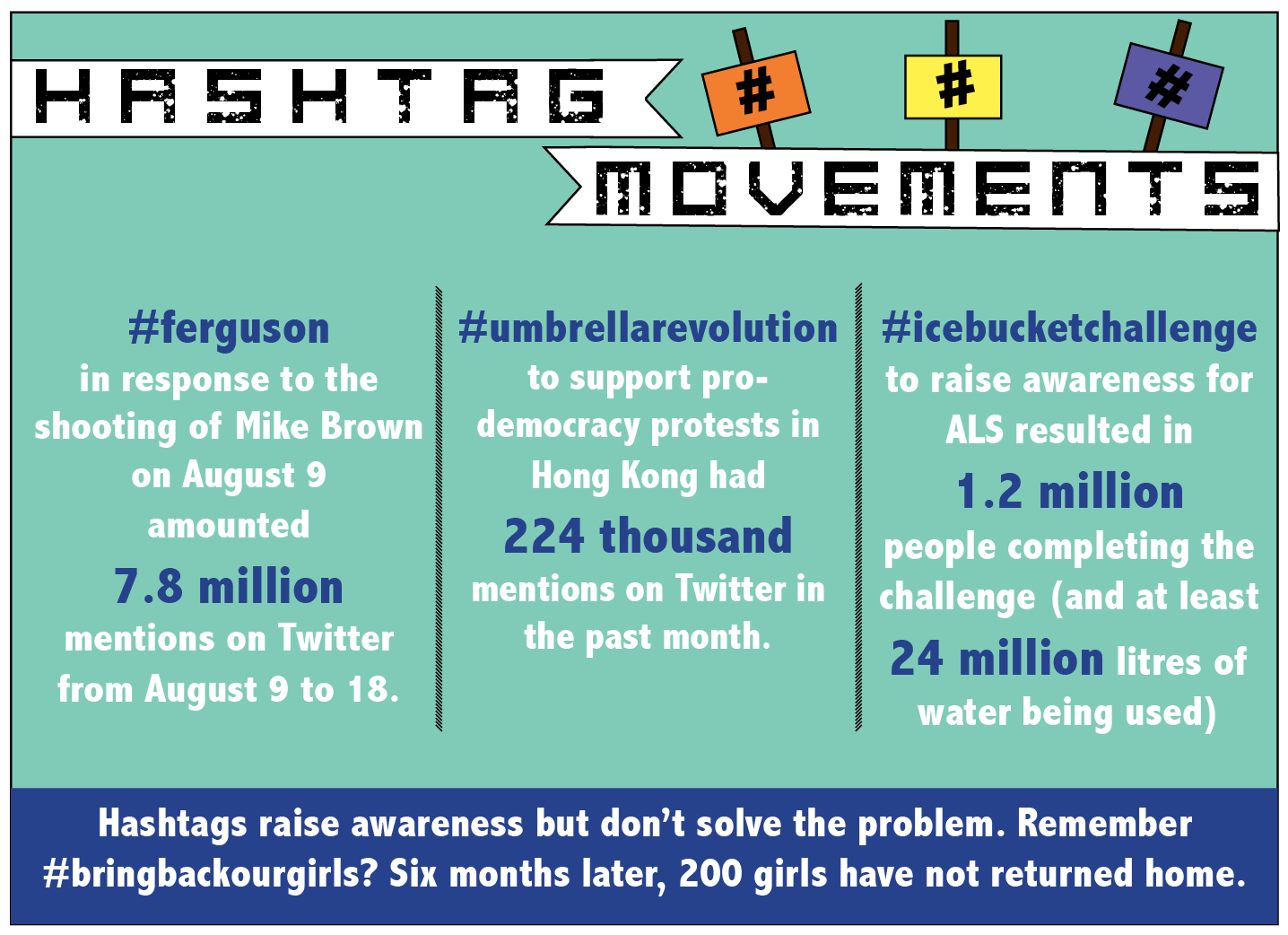
Beyond the need for real-world
solutions, the transience of the internet is also problematic in political and
social action. Causes are taken up at a frenzied pace and then fizzle out when a
new hashtag or social media campaign starts to gain popularity. Real change
requires the consistency of long term work and solutions, implemented over time
and constantly being re-evaluated for improvement. The fast-pace nature of
social media is not compatible with the nature of true solution-making.
Finally, the issue of misinformation
is social media is relevant to social activism. In the case of the Paris attack
on November 15, 2015, social media activity was criticized for photos that were
photo-shopped or outdated and spread online, going viral for days before anyone
realized that photos
were misleading or often down-right incorrect. The real danger of spreading
word so quickly is that there often lacks the checks and balances of verifying
that information is true before it becomes “online facts”. Social activism must
be wary when reaching out to the online world for aid – ensuring that causes
are representing correctly often cannot be efficiently monitored, especially once
a topic becomes viral.
Conclusion
Social media can function as the
loud speaker for a cause; the tool through which any given group or individual
can coordinate communications to the masses. Much like an effort to effect
change, the methods to achieve it can be successful or problematic.
I like the nuanced approach of
Shirky’s evaluation of social media’s role in a political sphere the best, even
though he speaks specifically of American political action:
“It would be nice to have a flexible
set of short-term digital tactics that could be used against different regimes
at different times. But the requirements of real-world statecraft mean that
what is desirable may not be likely. Activists in both repressive and
democratic regimes will use the Internet and related tools to try to effect
change in their countries, but Washington's ability to shape or target these
changes is limited. Instead, Washington should adopt a more general approach,
promoting freedom of speech, freedom of the press, and freedom of assembly
everywhere. And it should understand that progress will be slow.”
The bottom line: the reach of the
internet is restricted; those seeking change should explore all avenues to
affect the world around them. Social media, especially in today’s world,
definitely factors into the equation when it comes to spreading information and
gathering together groups. But social media users should take the time to
evaluate the real, “down and dirty” requirements that certain causes require –
sometimes this means difficult and uncomfortable work, and each social or
political cause should be evaluated to discover what truly needs to be done in
order to accomplish the goal.
References
Gladwell,
M. (2010, October 4). Small Change. Retrieved November 08, 2016, from http://www.newyorker.com/magazine/2010/10/04/small-change-malcolm-gladwell
Ahmad, B.
(2016, March 10). 10 Advantages and Disadvantages of Social Media for Society
-. Retrieved November 08, 2016, from https://www.techmaish.com/advantages-and-disadvantages-of-social-media-for-society/
White, S.
(2013, February 9). Social Media Growth 2006 to 2012. Retrieved November 08,
2016, from http://dstevenwhite.com/2013/02/09/social-media-growth-2006-to-2012/
Valenzuela,
S. (2013, March 6). Unpacking the Use of Social Media for Protest Behavior: The
Roles of Information, Opinion Expression, and Activism. American Behavioral
Scientist, 920-939. Retrieved November 09, 2016, from
http://abs.sagepub.com/content/57/7/920.full.pdf html
Shirky,
C. (2011, February 11). The Political Power of Social Media. Foreign
Affairs, 1-11. Retrieved November 09, 2016, from
http://sites.asiasociety.org/womenleaders/wp-content/uploads/2010/05/The-Political-Power-of-Social-Media-Foreign-Affairs2.pdf
Segovia,
C. R. (2014, November 04). Political Hashtagging: Is Online Activism Effective?
- Brown Political Review. Retrieved November 09, 2016, from http://www.brownpoliticalreview.org/2014/11/political-hashtagging-is-online-activism-effective/
Whitten,
S. (2015, November 16). Misinformation abounds following Paris attacks.
Retrieved November 09, 2016, from http://www.cnbc.com/2015/11/14/rumors-and-misinformation-circulate-on-social-media-following-paris-attacks.html

No comments:
Post a Comment