Friday, December 2, 2016

Discovering & Managing your Online Identity

           In today’s increasingly connected online world, one’s social identity is inevitable connected to what a person shares, establishes and interacts with on the internet (“Online identity”, 2010). Furthermore, a person’s online identity also becomes associated with any information that is shared by others that pertains to the individual. The result is a collection of photos, webpages, profiles and more that encompasses who you are on the internet.
In an effort to discover the challenges and options for managing one’s identity online, I did what many do when given the opportunity (and out of curiosity); I googled myself. I admit, I wasn’t expecting to see much as I consider myself conscientious about what I post and share online. The search results were limited but with a few surprises.


The first result was my LinkedIn page. I consider this an acceptable return as it is a public page that I have created to showcase my credentials and work experience to potential employers and current colleagues. I also find LinkedIn to be a practical way to network online. (The photo associated with this account was the only result under Images.) The second result was the most surprising – it was an outdated RSVP webpage to my wedding! The webpage showcases the date and time we were married, where we were married and a photo of my now husband and I. This pages was surprising because our wedding has long since passed and yet the webpage remains. The next two results were Facebook profile lists which included any Julia’s, Juliann’s or Julianne Wildschuts in the results – my profile was present under one of the lists but showed little of my account save my profile photo. The final results that were accurate to my online activity was three Facebook webpages I had liked: my in-law’s family business page, a photography page, and an annual local event page for the city where I live. Oddly enough, my results also had a link to my cousin’s newborn photos of their first son –apparently I had commented on this page back in 2013. Search results under my nicknames and maiden name returned no results.
Based on these results, I have a few stratagems for “cleaning up” my online identity and ensuring that my personal information is secure. Firstly, the search results that returned webpages that I have rated and/or liked reminded me to be vigilant about what I divulged online concerning my interests and shopping habits. I am taking account of any Facebook pages or Instagram/Pinterest accounts that may shape what kinds of ads, accounts or pages target me based on my “interests” online profile. The Internet Society refers to this as creating or shaping your “partial identity” – any avenue online where information about you is accumulated. It’s important that I link to appropriate and realistic information (that relates to who I am) in order to establish a healthy and accurate online identity. This requires that my browsing, liking, commenting behaviour is done in a conscientious way.
Any article, photo, post that I comment on should be responded to in a respectful manner and in a way that best reflects my personality. This is a strategy that I already believe I exercise in an unlaboured and natural manner online; however it’s always beneficial to be intentional when one responds to others, in person or not.
Any events pages (such as my wedding RSVP – but also Facebook events for fundraisers, parties, etc.) should be disabled once the event has passed. This will ensure that outdated or irrelevant information isn’t unnecessarily returned under my name. It may be a minor issue, but a good practice to put in place as a way of consistently managing my online presence.
Finally, protecting any password-accessed profiles is paramount to managing one’s online identity. Routinely, one should check one’s social media privacy settings, use complicated and different passwords for different accounts, assess one’s mobile phone privacy settings, and keep a lookout for phishing schemes such as odd emails or friend requests (Curtis, 2013). These basic protection strategies ensures your online identity isn’t tampered with by someone other than yourself and puts you in full control.


References

Curtis, S. (2013, December 11). 10 ways to protect your online identity. Retrieved December 02, 2016, from http://www.telegraph.co.uk/technology/internet-security/10509121/10-ways-to-protect-your-online-identity.html

Golbeck, Ph.D., J. (2014, October 15). Why We Overshare Online. Retrieved December 02, 2016, from https://www.psychologytoday.com/blog/your-online-secrets/201410/why-we-overshare-online

Online Identity Overview. (n.d.). Retrieved December 02, 2016, from http://www.internetsociety.org/online-identity-overview

Protecting Your Privacy. (n.d.). Retrieved December 02, 2016, from http://www.internetsociety.org/protecting-your-privacy

Protecting Your Identity. (n.d.). Retrieved December 02, 2016, from http://www.internetsociety.org/protecting-your-identity


Wednesday, November 9, 2016

Social Media and Activism: The Problematic Asset of Modern Change

       The power of social media, on the most global of scales, is that it has the ability to connect persons who might otherwise never interact, never form relationships, and never communicate with one another (Ahmad 2016). On the level of cost, those seeking to reach out to others are also able to do so with little monetary effort. With the growth of social media continually on the rise (White 2013) there is a large online audience within the reach of those looking to “spread the word” on any given topic or cause. Groups or individuals wishing to advocate or organize will inevitably utilize these ever-growing channels to perpetuate action, or at least to distribute information. The reality is that, like any effort to spur on change, social media tools have both benefits and disadvantages, and ultimately, may not always create the culture to spur on real-world action beyond the “walls” of the internet.

The Benefits of Social Media Activism

            Social media has its benefits to those seeking social or political action. Networking sites can be used by those looking to organize events, groups, and coordinate activities such as fundraisers or awareness events all at the click of a button. The convenience of organizing without having to physically meet or congregate during the planning phase allows advocators/fundraisers/etc. to pull together events quickly and conveniently. Sites like Facebook are set up to display information like times, places, participants, photos and discussion forums that aid coordinators pull together information in an organized and simple format. Beyond the simplicity of the medium itself, online organization through social media often gives users a voice; aids in building trust and participation between those involved, and empowers those involved to become content creators and distributors as part of their active participation online – activities such as putting together a Facebook event, tweeting out info on a cause, or sharing photos on Instagram that perpetuate the message can all empower persons who might not otherwise become involved and encourage those online participants to begin the work of becoming more physically involved.
The Problematic Nature of Social Media Activism: The Need for “Offline” Action  
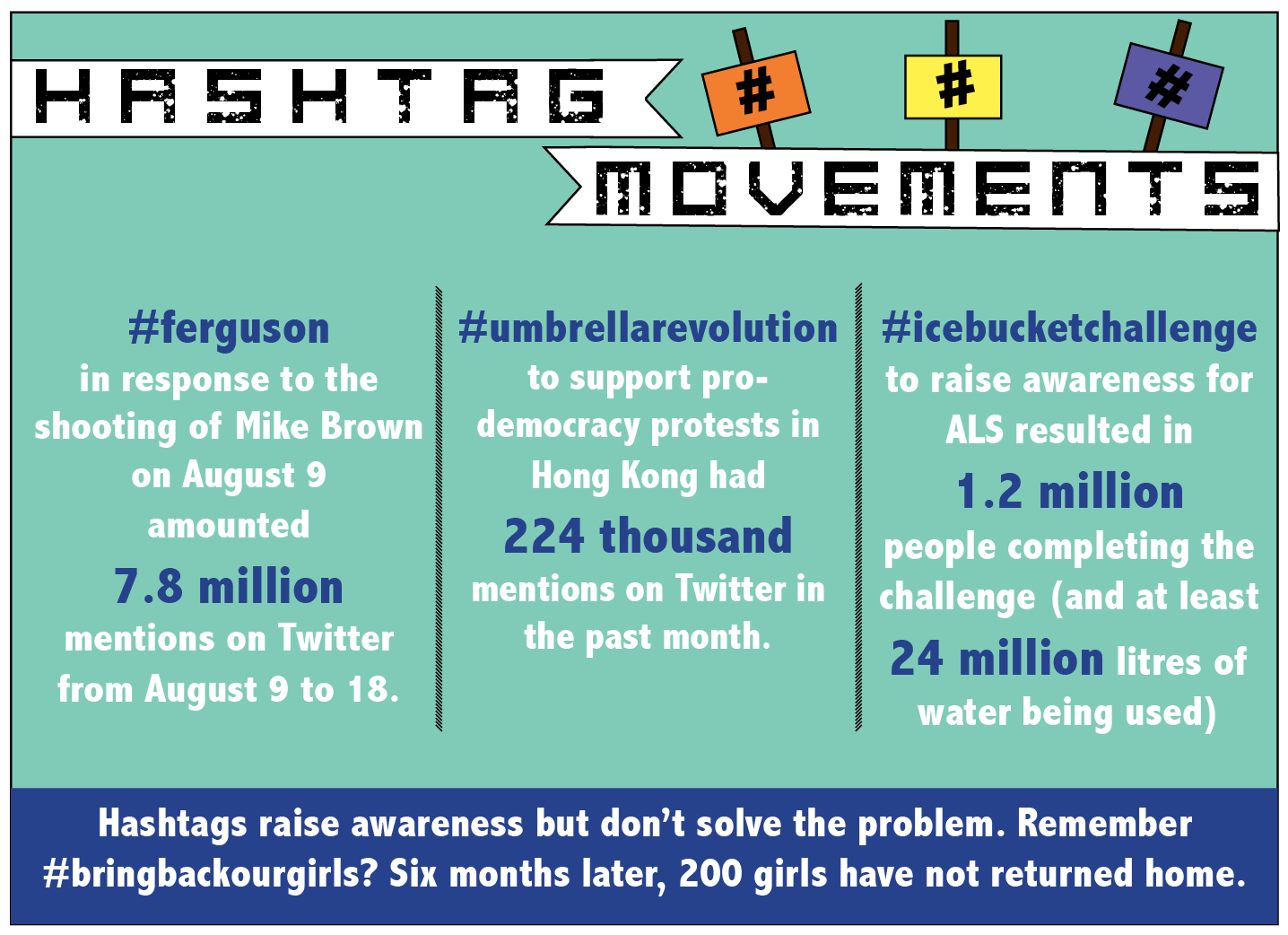
             There is research that has revealed that many people are now turning to social media to both read the news and to express political opinions. As a result, the natural progression is that social media is being used to join causes and to mobilize information and becoming the primary way to do so (Valenzuela 2013). With more and more online political awareness, it’s important to analyze the real-world results of such campaigns. Camila Segovia of the Brown Political Review examined the relationship between three different hashtag activism campaigns and their relationship to solutions. She found that these movements (see picture below for summary) inevitably raised awareness but did little to solve the issues they raised. In summary, Segovia highlights two important aspects of online activism that has the potential to create dangerously ineffective campaigns: “…it is important to remember that the social media platform is a means, not an end, for political action…Expanding political activism on Twitter should no substitute efforts undertaken in the offline world” (Segovia 2014). When users become involved online or participate in an online campaign, it is essential for those participants to consider how they could become more involved in a real-life working way. If there is no political action, that is, the physical and real plan to save the girls kidnapped by Boko Haram, then the campaign becomes fruitless. After all, a hashtag can’t travel to the Sambisa Forest.


            Beyond the need for real-world solutions, the transience of the internet is also problematic in political and social action. Causes are taken up at a frenzied pace and then fizzle out when a new hashtag or social media campaign starts to gain popularity. Real change requires the consistency of long term work and solutions, implemented over time and constantly being re-evaluated for improvement. The fast-pace nature of social media is not compatible with the nature of true solution-making.
            Finally, the issue of misinformation is social media is relevant to social activism. In the case of the Paris attack on November 15, 2015, social media activity was criticized for photos that were photo-shopped or outdated and spread online, going viral for days before anyone realized that photos were misleading or often down-right incorrect. The real danger of spreading word so quickly is that there often lacks the checks and balances of verifying that information is true before it becomes “online facts”. Social activism must be wary when reaching out to the online world for aid – ensuring that causes are representing correctly often cannot be efficiently monitored, especially once a topic becomes viral.

Conclusion

            Social media can function as the loud speaker for a cause; the tool through which any given group or individual can coordinate communications to the masses. Much like an effort to effect change, the methods to achieve it can be successful or problematic.             
            I like the nuanced approach of Shirky’s evaluation of social media’s role in a political sphere the best, even though he speaks specifically of American political action:
            “It would be nice to have a flexible set of short-term digital tactics that could be used against different regimes at different times. But the requirements of real-world statecraft mean that what is desirable may not be likely. Activists in both repressive and democratic regimes will use the Internet and related tools to try to effect change in their countries, but Washington's ability to shape or target these changes is limited. Instead, Washington should adopt a more general approach, promoting freedom of speech, freedom of the press, and freedom of assembly everywhere. And it should understand that progress will be slow.”
            The bottom line: the reach of the internet is restricted; those seeking change should explore all avenues to affect the world around them. Social media, especially in today’s world, definitely factors into the equation when it comes to spreading information and gathering together groups. But social media users should take the time to evaluate the real, “down and dirty” requirements that certain causes require – sometimes this means difficult and uncomfortable work, and each social or political cause should be evaluated to discover what truly needs to be done in order to accomplish the goal.


References

Gladwell, M. (2010, October 4). Small Change. Retrieved November 08, 2016, from http://www.newyorker.com/magazine/2010/10/04/small-change-malcolm-gladwell

Ahmad, B. (2016, March 10). 10 Advantages and Disadvantages of Social Media for Society -. Retrieved November 08, 2016, from https://www.techmaish.com/advantages-and-disadvantages-of-social-media-for-society/

White, S. (2013, February 9). Social Media Growth 2006 to 2012. Retrieved November 08, 2016, from http://dstevenwhite.com/2013/02/09/social-media-growth-2006-to-2012/

Valenzuela, S. (2013, March 6). Unpacking the Use of Social Media for Protest Behavior: The Roles of Information, Opinion Expression, and Activism. American Behavioral Scientist, 920-939. Retrieved November 09, 2016, from http://abs.sagepub.com/content/57/7/920.full.pdf html

Shirky, C. (2011, February 11). The Political Power of Social Media. Foreign Affairs, 1-11. Retrieved November 09, 2016, from http://sites.asiasociety.org/womenleaders/wp-content/uploads/2010/05/The-Political-Power-of-Social-Media-Foreign-Affairs2.pdf

Segovia, C. R. (2014, November 04). Political Hashtagging: Is Online Activism Effective? - Brown Political Review. Retrieved November 09, 2016, from http://www.brownpoliticalreview.org/2014/11/political-hashtagging-is-online-activism-effective/

Whitten, S. (2015, November 16). Misinformation abounds following Paris attacks. Retrieved November 09, 2016, from http://www.cnbc.com/2015/11/14/rumors-and-misinformation-circulate-on-social-media-following-paris-attacks.html

Sunday, October 16, 2016

The 48 Hour Challenge: Taking a Break from Social Media

    In Tammy Strobel’s article “A Magical Block of Time: Lessons Learned from my Digital Sabbatical”, Strobel challenges her readers to reflect on the benefits of taking time away from the online world and interacting with social media. In today’s ever connected world, it is becoming more and more common to spend as much time interacting with others online as it is in person. For instance, social media accounts for nearly 20% of time spent online in the US, according to Business Insider (Adler, 2016). Strobel emphasizes the importance of taking time to focus on the important aspects of life, including relationships, which for her requires a deliberate “stepping away” from the Internet in order to achieve a “magical block of time”.

    And so, I attempted to, as Strobel did, to remove myself from all social mediums for 48 hours – and failed miserably.

    In my own digital sabbatical experiences, I have found that it has become increasingly more difficult to achieve sustained abstinence from social media. This recent attempt to remove myself from social media for 48 hours was particularly tricky and I believe there are several factors that played into why.

    So why was this challenge so difficult for me? In the past when I had removed myself from social media, I was less connected to social mediums via my personal phone and other devices (as in, the technology I owned provided me less avenues to access social media). Now, not only do I own a smartphone, but also own an iPad, use a work device, and work on a computer daily for my current job. This makes sense, as studies have shown that social media is most often accessed via a mobile device. Strobel touched on why this “ready access” was an issue for me pretty accurately: “…when my writing projects got difficult or I started to feel insecure I had an urge to check my email or twitter. In some ways I think this behavior is a little like watching TV.” My abstinence experiment has taught me that I often use social media as a way to distract, to procrastinate, and most importantly to detach, even for a few minutes, in order to remove myself from the immediate and sometimes uncomfortable task at hand. Even now, as I write this blog post, I have checked my phone several times—perusing Instagram and Pinterest—before returning to writing. Social media can often serve as a balm to treat any uncomfortable feeling, even a feeling as seemingly insignificant as the discomfort of a writing block.

    I also believe that removing oneself from social media is becoming more difficult because there are so many popular social mediums available to a person. A social media website or app is only as strong as its user population, and with the increased numbers of people using social media globally, one is able to connect with more people via social media than ever before (Lee, 2015). When I stop using social media, I’m no longer just closing a door to communicate with some of my peers. My family members, my coworkers, my past teachers, my friends are all participating in online social interactions, and so, social media represents contact with all aspects of my social circle. Beyond the sheer volume of users, communication via social media has changed to include all types and ages of people who are using social media in a variety of different ways. The number of people participating in social media is only increasing. According to the BBC, by 2015, Facebook had over one billion people log on in a single day, with 1 in 7 people on Earth use Facebook to connect with others (Lee, 2015).


    I have found that even when I wish to take a break from social media, I am required to use it for work (this recently includes a social medium called Trello, which is a web-based project management tool where multiple users can contribute content to one project). Attempting to remove myself from these modes of interaction emphasized to me that I am (and society as a whole, I have observed) becoming increasingly more dependent on social media in order to communication – to anyone, no matter what their relationship is to me.

    I do not believe that a heavy reliance on social media is necessarily a bad thing. Social media connects our world on a more global scale, allows family and loved ones to stay close when physical proximity isn’t possible, and can expose a person to new ideas and ways of thinking or living. However, I do agree with Strobel that the practice of abstaining from social media to take time to reflect, build relationships in a tangible way, and to practice mindfulness, are invaluable habits to create in one’s life and in the lives of your family (that is, to teach one’s children to practice such intermittent abstinence). There is also very real evidence to suggest that engagement with social media can wreak havoc on one’s mental health, particularly children (Jameison, 2015) and that each individual should take measures to practice a healthy level of restriction. Dr. Cecile Andraessen and colleagues at the University of Bergen in Norway conducted a study on Facebook addiction and concluded that “people who are more anxious and socially insecure are more likely to use the social networking site.”(Whiteman, 2016).

    Finally, this experiment reminded me that using social media to constantly distract myself truly robs me from the human experience of being present. I love the quote Strobel includes in her article to highlight the beauty of the present moment: “Drink your tea slowly and reverently, as if it is the axis on which the whole world revolves – slowly, evenly, without rushing toward the future. Live the actual moment. Only this actual moment is life.” – Thich Nhat Hanh. I am quite determined to “fast” from social media in the future for this very reason – that the present moment is the basic building block of life, and that each moment should be treated with care and intention when decided how to spend it.


Sources:

Strobel, T. (2010, September). A Magical Block of Time: Lessons Learned from my Digital Sabbatical. Retrieved October 14, 2016, from http://www.rowdykittens.com/2010/09/a-magical-block-of-time/

Adler, E. (2016, July 07). Social media engagement: The surprising facts about how much time people spend on the major social networks. Retrieved October 15, 2016, from http://www.businessinsider.com/social-media-engagement-statistics-2013-12

Lee, D. (2015, August 28). Facebook has a billion users in a single day, says Mark Zuckerberg. Retrieved October 16, 2016, from http://www.bbc.com/news/world-us-canada-34082393

Jamieson, S. (2015, October 20). Excessive social media use harms children's mental health. Retrieved October 16, 2016, from http://www.telegraph.co.uk/news/health/children/11943810/Excessive-social-media-use-harms-childrens-mental-health.html

Whiteman, H. (2015, June 10). Social media: how does it affect our mental health and well-being? Retrieved October 16, 2016, from http://www.medicalnewstoday.com/articles/275361.php


Introduction

Hello readers and welcome to the blog of Julie Wildschut!

The goal and hope of this space (over the next few weeks in particular) is to take some time to write and reflect on current social media practices and study others who are experimenting, working with, or observing how, social media impacts the individual, as well as society as a whole.

Some of the topics you can expect to be covered include:
 - The impact of abstaining from social media in today’s ever connected world.
- How social media is used to facilitate change and promote activism (both the pros and cons).
- How our identities are tied to social media and the way we interact online.

I hope you enjoy reading about these topics as much as I enjoy writing about them. Feel free to comment or ask questions as you follow along!